
Charlotte Previous Residents by Era
Charlotte address history works best as a set of dated layers. The county's current parcel tools establish a present-day starting point. Register of Deeds indexes then connect legal transfers to earlier parties and legal descriptions. For a household layer, use annual directories, maps, newspapers, estate material, and census records only as sources for their own dates. A property owner, a tax mailing contact, and a person appearing in an old directory can be different people. Keep each role separate before treating any name as a past occupant.
| Source | Years it covers | Where held | What it can show |
|---|---|---|---|
| ROD modern real-estate index | March 1990 to present | Mecklenburg County Register of Deeds | Recorded instruments and the parties named in them. |
| ROD historical index and images | 1763 to February 1990 | Mecklenburg County Register of Deeds | Earlier instruments, book-page references, and historical images. |
| Charlotte directory references | Known local volumes from 1875; reference run noted 1897-1989 | Carolina Room and CMStory | Annual name, street, household, and notation clues. |
| Sanborn map collection | Charlotte scope 1867-1970 | Charlotte Mecklenburg Library and Library of Congress | Building, street, lot, block, and map-edition context. |
| Newspapers and county archives | Runs and record groups vary | Carolina Room, CMStory, and State Archives | Dated notices, obituaries, probate, land, court, and estate leads. |
Use the modern index when the transfer is recent. Move to the historical index when the purchase falls before the online cutover. For an older household question, the directory and map date may be more useful than a tax screen. None of these sources alone proves continuous occupancy.
Charlotte Deed Index Break
The Mecklenburg County Register of Deeds keeps two official real-estate search paths. The modern index begins with documents added in March 1990. The historical site covers 1763 through February 1990. This split is a useful first decision point for prior-address research. Do not stop if a name is not in the modern result set. Check whether the purchase belongs in the historical range, then search the correct index with the party role and the instrument details already found.
The Register of Deeds real-estate records overview documents the modern and historical coverage.
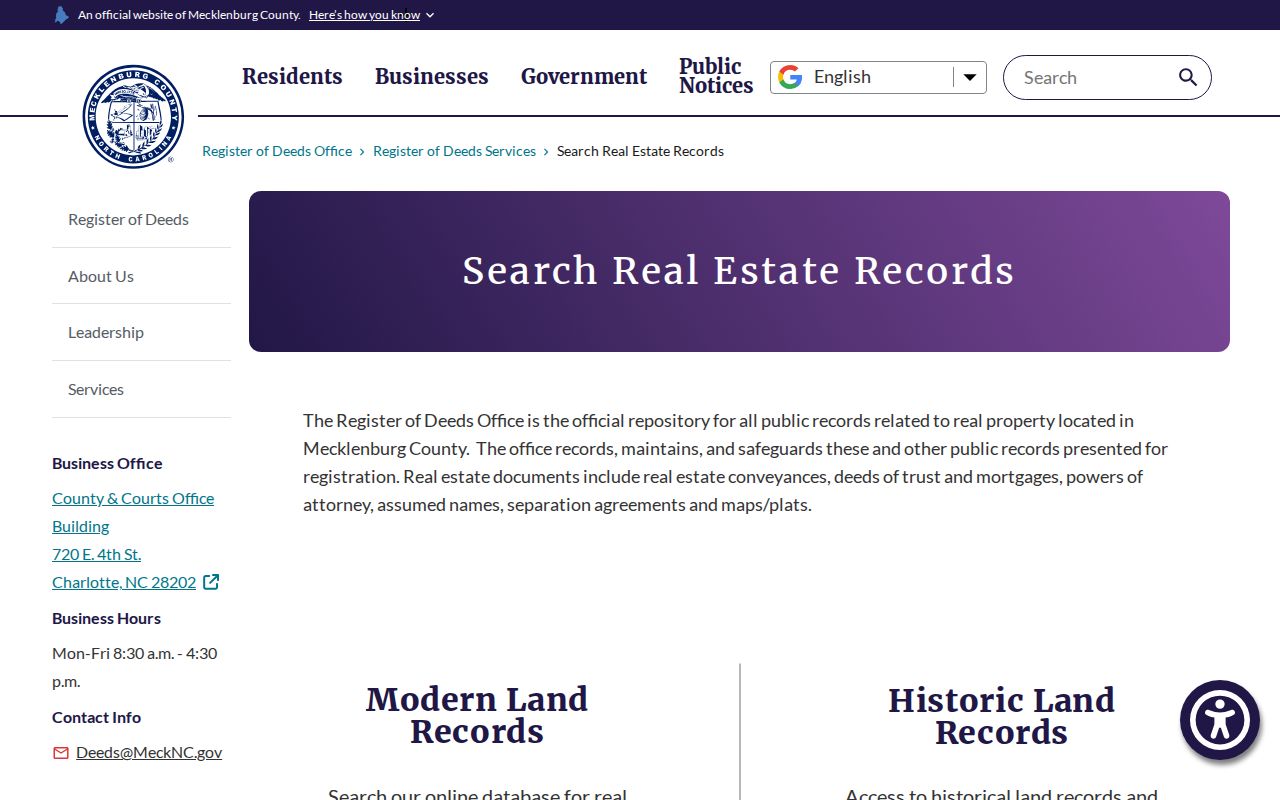
The two-index arrangement makes the recording date a key part of every past-resident search note.
Both online indexes are a starting point, not the only access channel. The Register of Deeds public-search vault is at 720 East Fourth Street, open Monday through Friday from 8:30 a.m. to 4:30 p.m., with 704-336-2443 listed for contact. Index access is free, while image and copy options follow the office's current rules. Mail and copy-request routes remain useful when an online image is unavailable or needs confirmation.
Charlotte House-History Sources
The Charlotte History Toolkit brings together the record types that make an address trail more reliable: newspapers, directories, plats, deeds, and permits. Start by writing down the exact address form from the source you have. Compare it with the parcel's legal description and road-name variants before searching a surname. A current street line can be newer than the building, while an older record may name a corner, lot, or street form that does not appear in a current map.
The Charlotte History Toolkit is the local house-history starting point shown here.
The toolkit's mix of directories, deeds, plats, permits, and newspapers encourages a dated comparison rather than a one-source answer.
Use the Carolina Room for library-held directories, historic maps, newspapers, yearbooks, photographs, municipal records, and family manuscripts. Its reference staff can help determine whether a particular source is on site, digitized, or subject to an appointment or library-access condition. The exact historical collections are also described on the Charlotte city directory page.
Tracing Charlotte Deed Chains
Start with the current situs address in the Mecklenburg County Office of Tax Administration tools and POLARIS. Record the parcel or PIN, situs, mailing address, legal description, and ownership context. The mailing line may belong to a remote owner, lender, estate, or manager. It is a contact or billing clue, not proof that someone lived at the property. Then identify the current grantee in the recorded purchase instrument and walk backward through the legal chain.
- Find the current parcel context and note the PIN, situs address, legal description, and the source date.
- Search the current grantee in the appropriate Register of Deeds index and open the purchase deed.
- Record the prior grantor, instrument number or book-page, plat reference, and legal description from that deed.
- Search that prior grantor as a grantee to find the earlier acquisition, then repeat the role reversal.
- Carry the legal description and plat through the chain when an old street name, number, or subdivision label changes.
- Grantor
- The party transferring an interest in the recorded instrument.
- Grantee
- The party receiving that recorded interest. In a backward search, the seller in one deed is often the buyer to search in an earlier one.
- Chain of title
- The dated sequence of recorded transfers and related instruments for the same legal property interest.
- Legal description
- The plat, lot, block, metes-and-bounds, or other formal parcel description. It can stay useful when a street address changes.
A deed chain identifies recorded property roles. It does not, by itself, identify past residents. Pair the legal trail with dated household evidence only after the address and time period line up.
Charlotte Parcel Dates Can Lag
Tax, GIS, and deed records can disagree for ordinary administrative reasons. The deed image may appear first, while a parcel owner or map attribute updates later. Mecklenburg CAMA metadata describes transaction-dependent processing windows of about 3-5, 5-10, or 30-60 days. Those intervals make a lag plausible; they do not establish the reason for any particular difference. Record the page date, instrument date, and lookup date before deciding which source reflects the newest transaction.
When a tax or GIS mailing address differs from the situs address, label it as a role field. A remote owner, estate, lender, or manager can receive mail without living there. The same caution applies to a permit applicant, contractor, or project contact. These records can date changes around a parcel without creating a household list.
Timing tip. Preserve the recording date and the portal access date together when POLARIS, tax, and deed data do not yet match.
Charlotte Address Changes Need Dates
Historic street naming, renumbering, annexation, new units, and subdivision changes can create a false break in an address history. The research does not establish one project-wide Charlotte renumbering date, so a broad date should not be invented. Instead, compare the source's exact address with the deed legal description, parcel, plat, Sanborn sheet, and dated directory spelling. The City Clerk's archives of minutes, resolutions, ordinances, and annexation material can help with a specific jurisdiction or street-change question.
The Charlotte City Clerk keeps civic records and routes records to the proper custodian when the question belongs outside City Hall. Court, deed, and vital material follows separate office routes. Historic addresses need the same jurisdiction check, especially near town boundaries or former county areas.
Charlotte Past Residents and Sanborn Maps
Sanborn maps help answer a different part of the question: what stood at the address around a particular edition date? Charlotte's collection spans 1867-1970 and can show building outlines, size, use, materials, lot and property boundaries, street and block numbers, railroads, wells, and other physical details. That can bridge a changed street grid or reveal that an old address described a different structure. It cannot name every past household, and a gap between editions does not prove that no building existed.
The Charlotte Mecklenburg Library Sanborn map collection is the source for this research path.
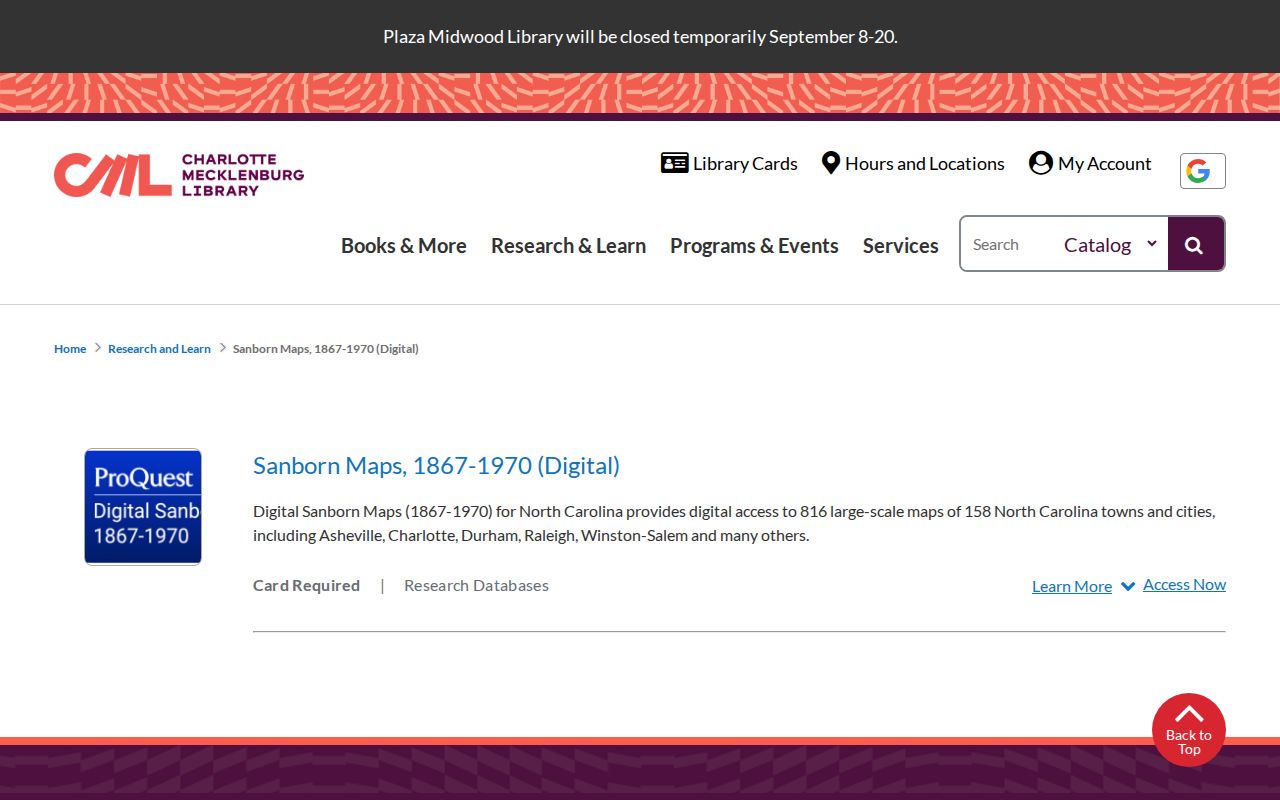
A dated map sheet can test the location and form of a building before a directory or newspaper clue is tied to the parcel.
Map editions commonly update about every five to ten years. Read the map key and sheet number, then compare the sheet date with the directory issue or deed date. The Library of Congress holds a Charlotte example covering a 1929 to February 1951 volume with 59 sheets, but map coverage is not continuous.
Charlotte Past Households by Year
Past residents require a household trail as well as an ownership trail. Charlotte directories are annual snapshots that can show a name, spouse or widow clue, occupation, employer, street, and “bds” notation. They can omit people, use initials, abbreviate street names, and preserve discriminatory historical classifications. Do not treat a co-address, a boarding notation, or a household label as proof of kinship. Match each entry to its own year and page before using it beside another source.
- Choose a confirmed directory year that is close to the deed or map date being studied.
- Transcribe the name, initials, street form, relationship clue, and page exactly as printed.
- Check nearby available directory years for a move, spelling variant, or the same address under another household lead.
- Pair the dated directory pattern with the relevant federal census year and keep conflicts visible rather than forcing a match.
- Use an obituary, probate file, cemetery inquiry, or newspaper notice as corroboration when it fits the time and place.
There is no verified online Charlotte reverse directory to search an address across a complete set of years. Forward books, address-indexed deed and parcel records, permits, newspapers, and the Carolina Room reference route are the documented alternatives.
Lawful personal use. Charlotte house-history and family-history research should respect protected records and never be used to harass, stalk, or track a living person.
Charlotte Newspapers and Probate Leads
Newspapers are often stronger for event timing than for proving identity. The local library lists Charlotte Observer image coverage from 1886-1984, text from 1985 forward, image coverage from 2018 forward, and web coverage from 2007 forward. CMStory microfilm adds distinct runs, including Charlotte News from 1888-1985, Charlotte Chronicle from 1886-1892, Charlotte Democrat from 1881-1897, and Charlotte Free Press from 1872-1897. OCR and incomplete runs can hide a useful item, so save the exact title, date, page, and issue searched.
The CMStory newspaper holdings provide the local-run detail. An obituary, notice, or advertisement can supply a date for a move, death, or event. It is not conclusive occupancy proof. Confirm it with a directory, deed, probate file, census, or other record that supports the same person and address.
Charlotte Archive Clues and Confidence
The North Carolina State Archives keeps finding aids for county court, land, estate, marriage, vital, tax, will, bond, census, and naturalization material. Mecklenburg County box lists can lead to wills, estates, civil and criminal actions, court minutes, divorces, and Register of Deeds land and marriage material. They are a route to record groups, not a complete index to every name. FamilySearch has North Carolina probate, deed, estate, and civil-action collections, but image access can require an account or an affiliate or library location.
The North Carolina Archives county record box lists are the official finding-aid path.
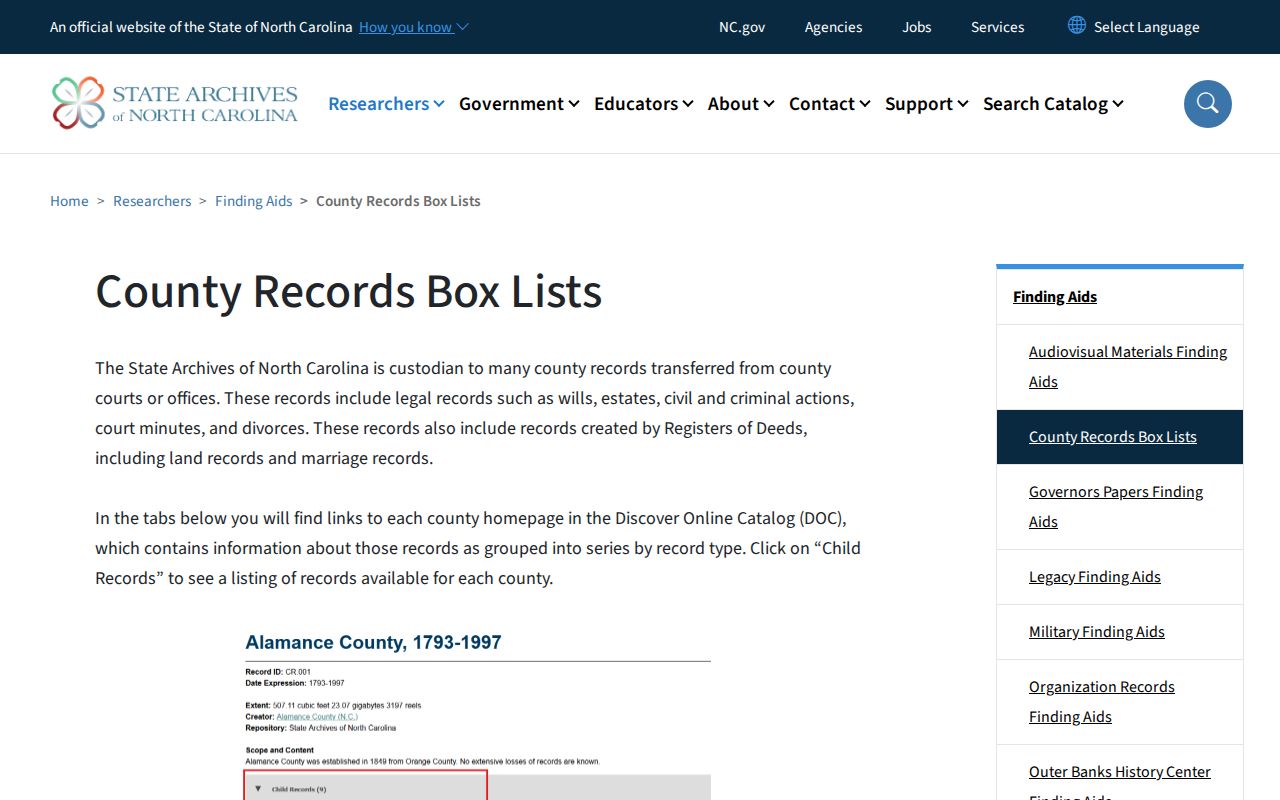
The finding aid can direct a researcher toward the right Mecklenburg record group when a web index ends.
Use a confidence label on every historical connection: direct for a record with a unique key and independent corroboration, probable where one gap remains, and historical lead for a directory, map, newspaper, or archive clue that needs more proof. The FamilySearch collection directory is an additional official collection finder, not a substitute for reviewing the underlying image and custodian rules.